
“Abortion to me means safety. Means control. Means equality. Means human rights.”
—Anna
Table of contents
- Define abortion
- why in news?
- Evolution of US Abortion Rights
- Evolution of abortion laws in India
- Evolution of Medical Termination of Pregnancy Act from 1971 to 2021
- MTP (Amendment) Act, 2021
- The recent order of the Supreme Court
- Conclusion
Define Abortion
The term “abortion” refers to the deliberate ending of pregnancy with the awareness that the fetus or embryo (including embryos and embryonic stem cells) will die as a result.
Why in news?
The Roe v. Wade decision, which declared abortion to be a constitutionally protected right, was reversed by the Supreme Court of the United States by a 6-3 decision. With a most recent ruling, the pro-life vs. pro-choice argument has been brought up not just in the United States but also around the globe. however, many world leaders have publicly denounced the US Supreme Court’s decision.
Moreover, in India, the apex court has even given a recent ruling on abortion laws. Where does India stand in the global debate over abortion rights? And what is the US’s history concerning abortion rights? Find out now
Evolution of US Abortion Rights
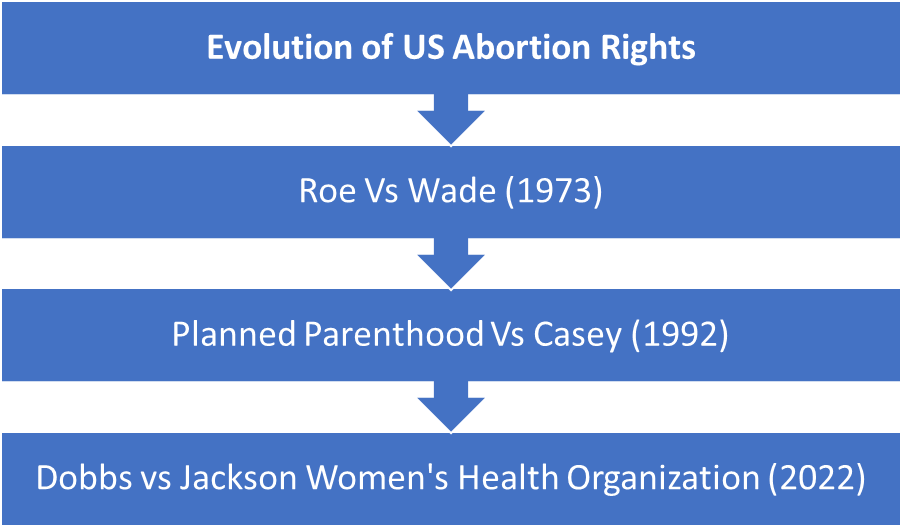
- Roe Vs Wade (1973)
When Jane Roe banged on the door of the judicial system, the Country was waiting for one of the most important rulings. When the Texas Constitution took away her right to choose, Roe demanded an abortion for her third pregnancy.
Roe, however, appealed to the U.S Supreme after succeeding in the lower court. On January 22, 1973, the Supreme Court revised the Constitution by a decisive vote of 7-2. Abortion in the US has now been made lawful through the proper legal channels and under the “right to privacy.”
Numerous federal and state abortion regulations were put on hold as a result of the ruling. Absolute rights were not given, though. Women had access to the option of having an abortion up until fetal viability, or the third trimester.
- Planned Parenthood Vs Casey (1992)
This important decision affirmed the Roe v. Wade ruling. Casey challenged the Pennsylvanian State Abortion Act, which had five regulations regarding abortion. The Supreme Court reiterated the key Roe Case finding with a 5-4 majority.
However, out of the five regulations, the Supreme Court invalidated only one, the provision requiring spouse notification. Declared to be unconstitutional. In certain situations, the court also permitted the states to establish limitations on first-trimester abortions.
In the jury discussion, the phrase “undue burden” was used frequently. Since this ruling, every situation involving abortion has been evaluated for “challenged limitations creating an undue burden on a woman’s freedom to choose.
- Dobbs vs Jackson Women’s Health Organization (2022)
The abortion clinic of the Women Health Organization challenged the Mississippi law. They viewed Mississippi’s abortion law, which only permits abortions up to 15 weeks, as being backward and authoritative.
The Supreme Court considered the issue, engaged in extensive deliberation, and came to the most shocking conclusion. It overturned precedent and deprived American women of their fundamental right to an abortion.
Evolution of abortion laws in India
- The Union government established the Shantilal Shah Committee to consider the legalization of abortion in the nation in the 1960s as a result of a high rate of induced abortions.
- In 1971, the Medical Termination of Pregnancy (MTP) Act became operative. This law establishes the guidelines for how and when a medical abortion may be performed. It is an exemption to the Indian Penal Code (IPC) provisions 312 and 313.
- A person who “voluntarily induces a woman with child to miscarry” is subject to punishment under Section 312 of the IPC, which carries a maximum three-year prison sentence, a fine, or both, unless it was done in good faith to preserve the pregnant woman’s life.
- According to Section 313 of the IPC, a person who induces a miscarriage without the pregnant woman’s agreement, regardless of whether she is at an advanced stage of pregnancy, shall be punished with life in prison or a period of imprisonment that may last up to 10 years, as well as a fine.
Evolution of Medical Termination of Pregnancy Act from 1971 to 2021
- The MTP Act underwent its most recent modification in 2021.
- Before that, new regulations were put in place in 2003 to permit the use of the recently discovered abortion drug misoprostol to end a pregnancy medically up to seven weeks into it.
- The original Act was subject to broader modifications in 2020, and the revised Act took effect in 2021.
- Abortion is legal following a doctor’s recommendation under certain conditions, according to the Medical Termination of Pregnancy (Amendment) Act of 2021.
- The 2021 Act expanded the maximum gestational period to which a woman may obtain a medical abortion from the 20 weeks allowed by the 1971 Act to 24 weeks.
- Up until 20 weeks of gestation, MTP could not be accessible based only on the recommendation of a single licensed medical professional.
- Two licensed medical professionals’ opinions are needed between 20 and 24 weeks.
- In the earlier version of the Act, a registered doctor’s opinion was needed to obtain a medical abortion up to 12 weeks of pregnancy, and two doctors’ opinions were needed to obtain an abortion up to 20 weeks.
MTP (Amendment) Act, 2021:
- Failure of Contraceptive Technique or Device: According to the Act, a married woman may choose to end a pregnancy up to 20 weeks early if a contraceptive method or device has failed.
- Unmarried women: For this reason, it is also permissible for unmarried women to end a pregnancy.
- Opinion Required for Pregnancy Termination:
- opinion of a single Registered Medical Practitioner (RMP) about abortion of pregnancies with a gestational age of up to 20 weeks.
- Opinions of two RMPs about the termination of pregnancies between 20 and 24 weeks. If there are significant fetal abnormalities, the State-level medical board’s approval is required before a pregnancy can be terminated after 24 weeks.
- Increases the upper gestational limit for particular categories of women, including those who have been raped, have experienced incest, and other vulnerable women, from 20 to 24 weeks (differently abled women, minors, among others).
- Confidentiality: Only those individuals permitted presently by effect laws may receive the “name and other particulars of a woman whose pregnancy has been terminated.”
The recent order of the Supreme Court
- Law applied to “unmarried” women: A 2021 update to the Act changed the phrase “spouse” to “partner,” making it clear that the law applied to unmarried women. SC so permitted abortions on women.
- The court mandated that the AIIMS organize a medical board to determine whether it was safe to perform an abortion on the woman and to produce a report within a week.
- An unmarried woman’s autonomy and freedom are violated when her right to safe abortion is denied. According to Article 21 of the Constitution, a woman’s right to reproductive freedom is an integral aspect of her right to personal freedom. She has a sacred right to maintain her physical integrity.
Note:
In Justice K.S. Puttaswamy (Retd.) vs. the Union of India and Others (2017), the court acknowledged the constitutional right of women to make reproductive choices as a part of personal liberty under Article 21 of the Indian Constitution, which, despite establishing a strong body of law on reproductive rights and a woman’s right to privacy, does not result in a significant transfer of power from the doctor to the patient seeking an abortion.
Conclusion
People can have agency and control over their bodies if they have access to safe and legal abortions. Reversing Roe v. Wade effectively means that a fetus or embryo is more important than the mother’s physical and mental well-being (and that the mother isn’t capable of making that choice for herself).
People who are residents in rural areas, and low-income individuals—who already disproportionately face hurdles to accessing quality health care—are disproportionately impacted by this racial and social justice issue. Wealthy people will merely move to states where they can access the care they need. People with lower incomes and socioeconomic levels will be compelled to have children they cannot support. As a supporter of women’s health, I hope for the day when all women, regardless of race or socioeconomic status, will have access to inexpensive, sufficient health care, which includes the freedom to have an abortion if she so chooses. When will our country fulfill the promise of “life and liberty for all”?

 The Legal Lens: A Deeper Look
Great piece! Thank you for this article
LikeLike
Love the article very well written and also helps a lot in gaining extra knowledge about the abortion laws in US
LikeLike